

A few drops of water fell on my suede leather shoe and it just about wrecked the leather. It reminded me why my schoolmates who wore Clarks Desert Boots would always have plastic bags with them. When it rains they tied the bags over the shoes to protect the suede. It looks hideous but quality shoes comes at a price. This change in the character and colour of leather when it interacts with water has always fascinated me. Maybe you have never wonder what is happening when a few drops of water fall onto your leather shoe but I have. Here’s the what, why and how about Leather.
 |
| IMAGE: long-john.nl |
Leather is a durable and flexible material made by tanning of the hide or skin from animals, particularly cattle.
After the skin is removed from the animal (cattle, goat, kangaroo), if left to moisture, it will rot. However, if the water content is reduced then it becomes hard and brittle. Tanning is the process of permanently altering the structure of the proteins in the hide such that the material is resistant to hot water and bacteria whilst also making it more flexible.
Tanning is commonly done with either chemical agents from plants or chromium salts. This process is normally carried out in a tannery.
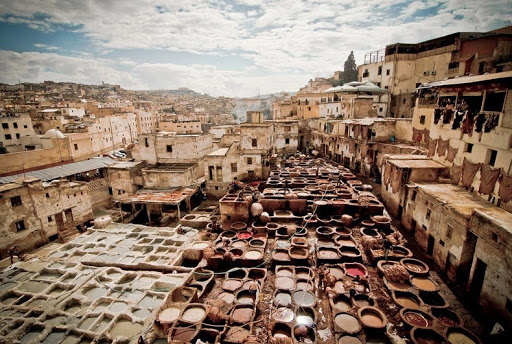 |
| IMAGE: Chris Zieleki |
There are a few steps before the hide is reading for tanning:
- soaking: the skin is rehydrated and cleaned to remove any impurities and grime.
- unhairing and liming: this operation chemically removes animal hairs.
- fleshing: at this stage, the subcutaneous tissue is mechanically removed.
- bating: this process is used to start softening the leather.
- pickling: at this stage, the skin is acidified to prepare it to undergo the tanning process.
It is really at this stage that the skin/hide is converted into leather. As indicated earlier, tanning can utilize chemical agents from plants or chromium (chromium is mineral) salts. The barks of some trees contain tannins (polyphenolic compounds) which chemically alters the protein in the skin (collagen). This reaction causes the material to be less water-soluble and less susceptible to bacterial attack. The leather produced via this route is most often used to make luggage, footwear, belts and other accessories. However, the process is time consuming as it may take up to 3 weeks for completion.
Using Chromium salts for tanning requires less time and produces different characteristics in the leather. The pre-treated hide is immersed into a bath containing the chromium salts (chromium complexes dissolved in solution) and the leather produced is stretchable and finds use in handbags and garments.
The process isn’t at all complete at the end of tanning, but it’s far too complex to share here. If you’re interested then you can check out all-about-leather or Fédération Française de la Tannerie Mégisserie.


ASOS – Jack & Jones Leather Belt
 |
| IMAGE: archules.com |
Two main things damage leather: moisture and heat. The material was designed to be water resistant and thus moisture only reverses the process. The simple advice is to avoid getting your leather product wet. Experts suggest that persistent wetting and drying distorts the shape of the leather.
When cleaning smooth or waxed leathers, a slightly damp cloth is sufficient. A protective wax is then applied and the surface can be buffed.
Cleaning suede is a completely different technique. Normally a soft brush is used so as to maintain the velvet texture. If the suede is “dead” or “napping” because of a stain, then you will need a crêpe brush.
 |
| Saphir Crepe Brush: $20.00 |
There are other products that you can use to restore your suede if things really get bad.

*Featured Image: Pinterest
 ASTOR TATE